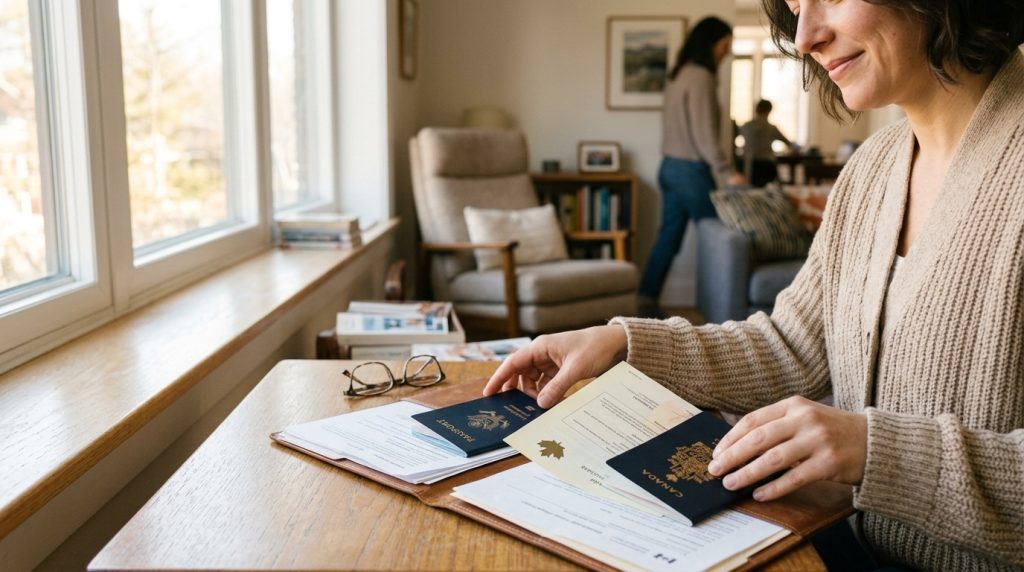
A confirmed citizenship by descent case in your family can make your own application much easier. If a sibling, cousin, or other blood relative has already proven the same Canadian family line, their records and research may help you build a stronger file. Still, each person must submit complete evidence to IRCC and meet today’s legal requirements on their own.
When one family member’s citizenship proof can help everyone else
A successful proof of Canadian citizenship application in one branch of a family can create a valuable starting point for others. In practical terms, if a close blood relative has already shown IRCC that a parent, grandparent, or great-grandparent was Canadian, that earlier work may support your own case.
This matters because citizenship by descent is based on a direct parent-to-child line. If your family tree and your relative’s family tree meet at the same Canadian ancestor, the upper part of your evidence may overlap. That can save time, reduce duplicate research, and help you understand what documents IRCC has accepted before.
For people exploring broader Canadian immigration pathways, this is an important reminder that not every route to Canada begins with a visa or permanent residence application. Some people may already have a claim to citizenship and simply need to prove it.
Why a relative’s file can be useful
If one family member has already received a citizenship certificate, they may have located birth records, marriage records, name change evidence, church records, provincial civil documents, or older identity records that connect the family line to a Canadian-born ancestor. That can be especially helpful where records are old, inconsistent, or spread across provinces and countries.
Many families discover that one person does the hard genealogical work first, and others benefit later. A sibling’s approved file is often the strongest example because siblings usually share the same direct line. A cousin’s approval can also help, especially where both applicants descend from the same grandparent or great-grandparent.
Which relatives can support your claim, and which cannot
Not every family connection is legally relevant. What matters is whether you and the other person descend from the same Canadian ancestor through a biological or legal parent-child chain recognized for citizenship purposes.
Relatives who may be helpful
A brother or sister is usually the clearest example because the family line is nearly identical. A first cousin may also be very useful if both of you descend from the same Canadian grandparent. In some cases, even more distant relatives, such as second cousins, can still help if the shared Canadian ancestor appears in both direct lines.
The key question is simple: does your claim run through the same Canadian ancestor, generation by generation, without relying on marriage-only relationships?
Relatives who generally do not help
Family members connected only by marriage usually cannot establish your citizenship line. That means an aunt by marriage, a spouse, or a step-sibling cannot serve as the foundation of your claim if there is no shared descent from the Canadian ancestor.
IRCC is not assessing family closeness in an emotional sense. It is examining legal lineage and documentary proof.
An important rule for younger generations born abroad
There is also an important date to keep in mind. For some children born outside Canada on or after December 15, 2025, an extra requirement may apply if their Canadian parent was also born outside Canada. In those cases, the parent may need to show at least 1,095 days of physical presence in Canada before the child’s birth.
This newer rule can affect families with multiple generations born abroad, even where older relatives had no such issue. Anyone comparing their case to a sibling’s or cousin’s should be careful not to assume the law is identical across generations.
If you are unsure whether citizenship by descent or another route is better, it may help to assess your immigration options before investing time in the wrong process.
What can carry over from a relative’s successful application
A previous family approval does not transfer citizenship automatically, but it can give you three major advantages: evidence, strategy, and context.
Shared research and documents
The biggest benefit is often the research itself. If your relative already found the Canadian ancestor’s records and traced the line down through children and grandchildren, you may be able to use that same roadmap. You would still need your own official copies, but you would not be starting from zero.
This can be especially useful where surnames changed over time, records were issued in French, or older provincial documents need updated certified versions. Quebec records, for example, can raise special document issues depending on when the certificate was issued and whether IRCC accepts that version.
A stronger explanation for your own file
A prior approval may also help you explain your case more clearly. In a cover letter, you can identify the related family application and explain how your line connects to it. That does not replace evidence, but it gives the officer useful context and may make your package easier to follow.
Good explanations matter in many immigration processes, not only citizenship files. Whether someone is applying for Express Entry immigration to Canada, a work permit, or proof of citizenship, clear records and consistent facts are essential.
A practical model for solving problems
Families often face the same documentary obstacles. One relative may already have dealt with missing birth registrations, spelling differences, delayed records, or conflicting dates. Their approach can help you prepare your own letter of explanation and gather better evidence from the start.
That kind of preparation is no different from other immigration streams. For example, applicants under the Provincial Nominee Program or those planning to immigrate through the Atlantic Immigration Program also need careful documentation, accurate forms, and a strategy that matches the rules in force at the time of filing.
The limits: each application still stands on its own
Even with a strong family precedent, IRCC reviews every citizenship application individually. Officers decide cases based on the evidence in the file before them. In legal terms, the decision is made on a balance of probabilities, meaning the documents must show that it is more likely than not that you are a Canadian citizen.
You still need your own complete package
You cannot simply ask IRCC to look at your cousin’s file and approve yours. You must submit your own forms, your own identity documents, and your own official records from the issuing authorities. If the family line overlaps, the evidence may be similar, but it still needs to be in your package.
This is a useful lesson for anyone comparing immigration routes. Whether you are considering permanent residence in Canada, a study pathway, or citizenship proof, every applicant needs a file that can stand independently.
Earlier approvals are helpful, but not perfect
A previous approval does not guarantee that the earlier case was thoroughly documented. If a relative succeeded with weak or incomplete evidence, copying that file could repeat the same problem. The safest approach is to treat the earlier application as a guide, not as a final answer.
That is why legal review can be valuable. A licensed professional can examine the family history, identify missing links, and help present the strongest possible submission. This can be particularly important where records come from multiple countries or where there are adoption, legitimacy, or name variation issues.
Can families apply together?
Yes, families can send multiple proof of citizenship applications in one package. This can help keep related files together and may make it easier to include a shared explanation of the family tree. However, each application still needs its own complete document set.
There is also a risk. If IRCC finds one application incomplete, the whole package may be returned. For some families, filing together makes sense. For others, especially where one person has a more complicated record problem, separate submissions may be the safer choice.
People who are not eligible for citizenship by descent may still have excellent alternatives, including the Federal Skilled Worker Program, regional pathways, family sponsorship, or work-permit-based strategies. If language testing such as IELTS, CELPIP, TEF, or TCF, an Educational Credential Assessment (ECA), or Canadian work experience becomes relevant, a different route may ultimately be faster and more realistic.
Canadian immigration rules change often, and citizenship by descent cases can be highly fact-specific, so readers should always confirm current requirements with IRCC or speak with a licensed immigration professional before making decisions. EverNorth Immigration is here to help with experienced, compassionate support at every stage of your journey toward a new life in Canada, whether you want to confirm a citizenship claim or book your free immigration assessment for a professional evaluation of your options.